UNIVERSTAR
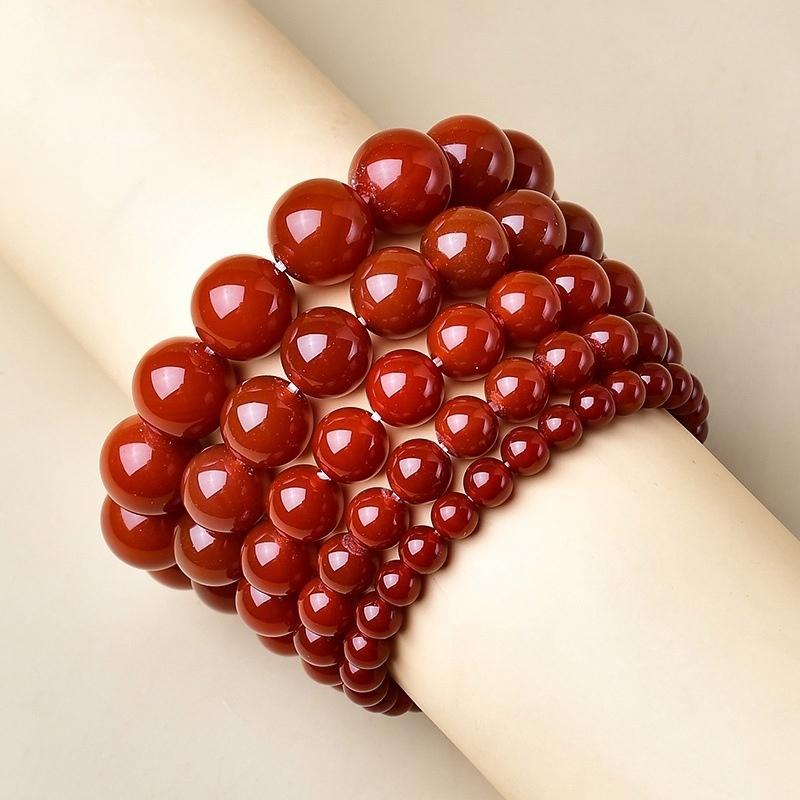
Red Agate Bracelet - The Fire Element
Red Agate Bracelet - The Fire Element
无法加载取货服务可用情况
Most red agate is not born red. Heat is what turns it, and that is not a trick.
Agate comes out of the ground in bands of grey, brown and dull yellow. The deep red you see in almost every red agate bracelet — including the honest ones — is the result of gentle heating: the stone is raised until the iron inside it oxidises and the colour turns. It is permanent, it runs through the whole bead, and it is how this material has been prepared for centuries.
Dye is the other method, and it behaves differently. Dye sits in the surface and in the cracks rather than in the stone itself. We explain how to tell the two apart further down, because it is the one question worth asking about any red agate you buy, from us or anyone else.
Agate belongs to the Fire element — the phase of drive, warmth and getting things moving. It has been worn as a general-purpose auspicious stone for centuries, usually in exactly this form: a plain strand of deep red beads with nothing on it that needs explaining.
Why people wear it
- For momentum. Fire is the element of drive and appetite. Agate is the plain red stone you wear when you want to get moving.
- As a daily piece. No accent bead, no charm, no maintenance beyond a wipe — and hard enough to survive being worn constantly.
- If your chart favours Fire. If your BaZi chart comes back Fire, this is one of the materials traditionally worn to support it.
- For the colour without the price. The same deep red family as the collector's stones in this collection, at everyday money.
What you get
| Material | Natural agate |
| Colour | Deep red |
| Beads | Round, polished |
| Cord | Elastic, knotted |
| Fit | Unisex, one size, fits most adult wrists |
| Weight | 60 g |
| Finish | Hand-strung |
Questions we get
Is the red natural, or is it dyed?
Red agate is almost always colour-enhanced. Naturally red agate exists, but it is uncommon and expensive, so the deep red you find in the trade is produced by heating: the stone is raised until the iron in it oxidises and the colour turns red through the whole bead. That process is permanent and is the standard for this material. Dyeing is the other method, and it is the one worth avoiding.
How do I tell heat-treated agate from dyed?
Look at the drilled hole and at any natural cracks. Dye collects in both, so they look darker than the surface — almost like a stain running into the stone. Heat-treated agate is the same colour at the hole as anywhere else. Hold a bead up to a light: heat-treated agate usually still shows uneven colour and faint banding, because it is still a natural stone underneath.
Will the colour fade or rub off?
Heat-treated agate does not fade. It is not a coating — the colour is inside the stone. Dye can fade in strong sunlight and can leave marks on skin when the bracelet is wet, which is one more reason the trade prefers heat.
Can I wear it in water?
The stone will not mind at all. Agate is quartz, and water does nothing to it. The part that ages is the elastic cord, so take it off for swimming and showering and the bracelet will last for years rather than months.
How do I know whether Fire is my element?
You can check in about thirty seconds with the chart tool on our home page. Enter your birth date, time and city, and it will show your four pillars and which element your chart favours. If it comes back Fire, this is the bracelet that matches.
Care
Agate is one of the hardest stones we carry, so it takes daily wear well. The thing that ages is the elastic, not the stone: remove it for swimming and showering. Wipe with a soft dry cloth.
We explain charts; we don't sell predictions. A stone is a reminder you chose, not a promise of an outcome.
分享