UNIVERSTAR
Malachite Bracelet - The Wood Element
Malachite Bracelet - The Wood Element
Couldn't load pickup availability
In Chinese it is called the peacock stone. The bands are the reason.
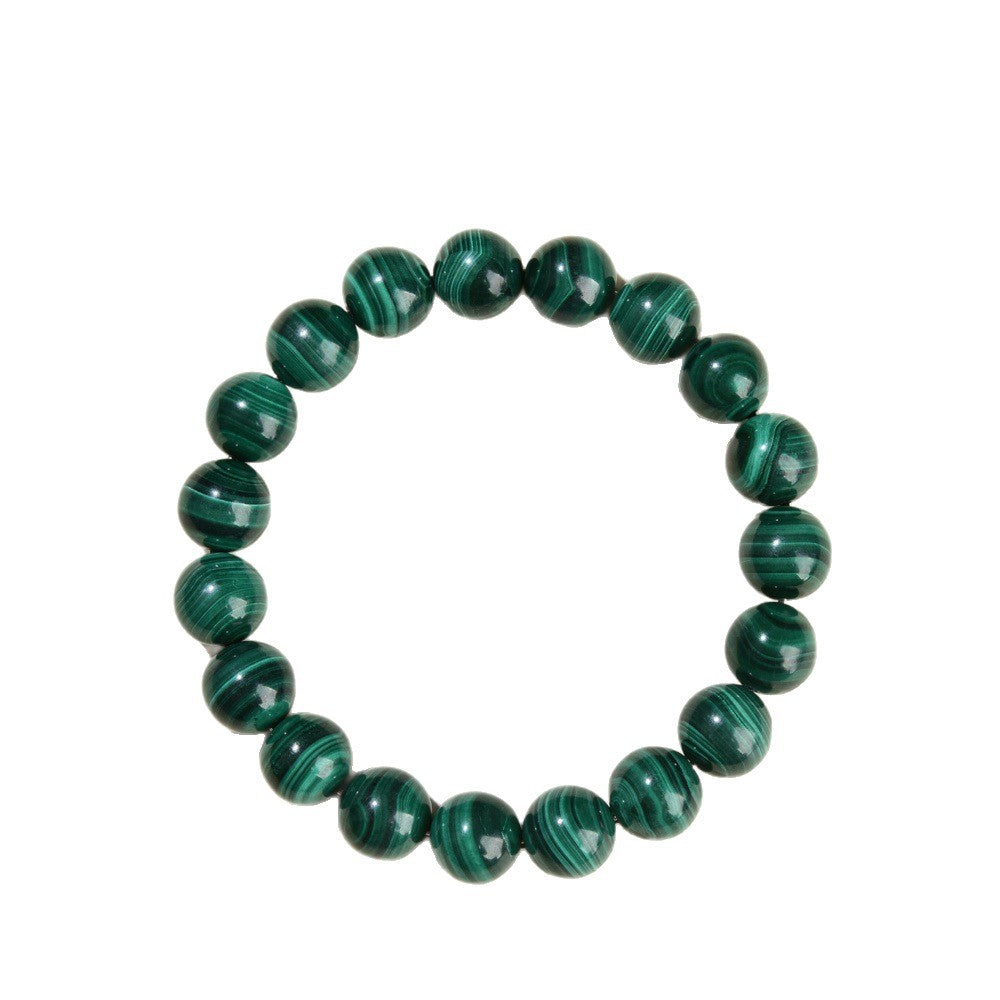
Malachite forms in thin layers inside copper ore, and the layers run from pale green through emerald to almost black. Cut a bead anywhere and you get a different slice across them. The Chinese name refers to the eyes on a peacock's tail, and once you have seen a strand of this up close it is hard to unsee it.
It belongs to the Wood element, but to a different side of it than aventurine. Aventurine is the stone of forward motion. Malachite is the one worn at the end of something, in the gap before the next thing starts — when the work in front of you is clearing rather than building.
It has been mined for copper for more than five thousand years and ground into green pigment in Egypt, Greece and China long before anyone thought to wear it. It is what copper becomes after the weather has been at it for a few million years, and it still carries that feeling: a stone that has already been through something.
It is also the softest stone we sell apart from amber, and it needs to be treated accordingly. That is covered under Care, and it matters more than anything else on this page.
Why people wear it
- At the end of something. Malachite is the traditional stone for the gap between finishing and starting.
- Because no two beads match. Every bead is a different slice across the layers, so the pattern never repeats.
- If your chart favours Wood. If your BaZi chart comes back Wood, this is one of the materials traditionally worn to support it.
- For the darkest green there is. Teal, emerald and near-black in one strand. Nothing else here looks like it.
What you get
| Material | Natural malachite |
| Colour | Banded green, pale to near-black |
| Beads | Round, polished |
| Cord | Elastic, knotted |
| Fit | Unisex, one size, fits most adult wrists |
| Weight | 60 g |
| Finish | Hand-strung |
Questions we get
Is this natural malachite, or reconstituted?
A great deal of cheap malachite is reconstituted: malachite dust mixed with resin and pressed into beads. You can usually spot it because the banding looks soft and broken up instead of running in clean parallel lines, and the whole strand looks unnaturally even. Natural stone has crisp bands, and the direction of those bands changes from bead to bead. Ours is cut from solid stone, not pressed.
Can I wear it in water?
No, and this is the one thing worth remembering. Malachite is soft — around 3.5 on the hardness scale, softer than anything else we sell except amber — and it is a copper mineral, which means acid dulls it. Perfume, hairspray, sunscreen, hand sanitiser and lemon juice all count. Take it off before you wash your hands, shower or swim.
Will it stay this shiny?
Yes, if you keep it dry and put it on last. The shine sits on the surface, so what dulls malachite is abrasion and acid rather than time. Store it in a pouch rather than loose in a jewellery box, where it will rub against harder stones.
Why is every bead different?
Because malachite forms in layers and each bead is cut across them at a different angle. Some bands run straight through the middle of a bead, others curve around it. Two beads cannot match, which is either the best or the worst thing about this bracelet depending on what you wanted.
How do I know whether Wood is my element?
You can check in about thirty seconds with the chart tool on our home page. Enter your birth date, time and city, and it will show your four pillars and which element your chart favours. If it comes back Wood, this is the bracelet that matches.
Care
Keep it dry. Remove it before washing your hands, showering, swimming, exercising or applying perfume, sunscreen or hand sanitiser — malachite is a soft copper mineral, and both abrasion and acid dull it. Put it on last when you get dressed, and store it in a pouch away from harder stones.
We explain charts; we don't sell predictions. A stone is a reminder you chose, not a promise of an outcome.
Share