UNIVERSTAR
Cinnabar Bracelet - The Fire Element
Cinnabar Bracelet - The Fire Element
Couldn't load pickup availability
This is the red China wrote with.
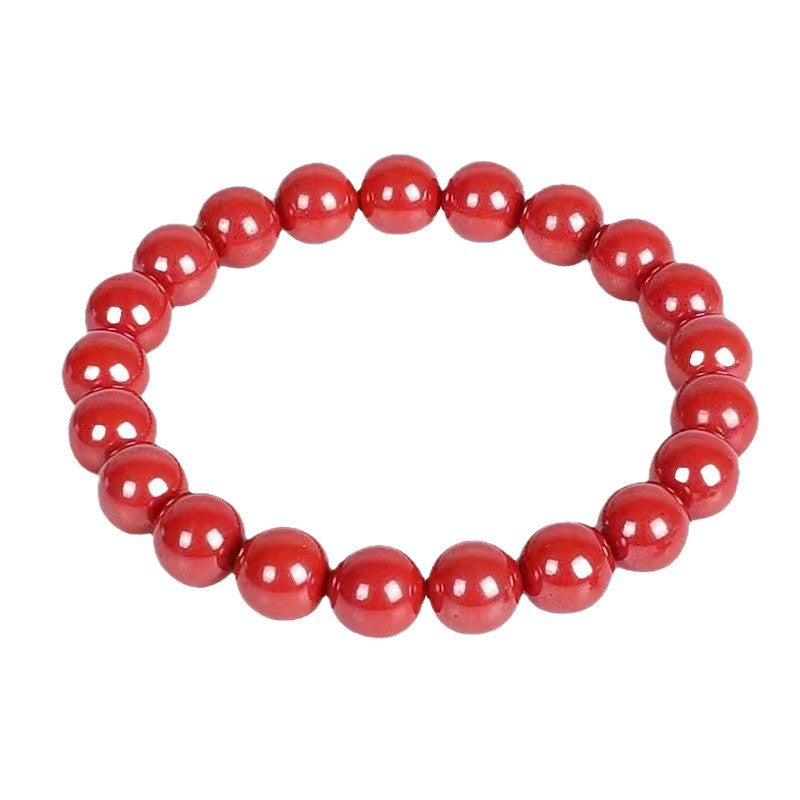
Before it was a bracelet, cinnabar was ink. Seal paste is ground cinnabar. The red an emperor used to write his comments down the side of a document — the vermilion endorsement, the zhu pi — was cinnabar. Talismans were written in it, tomb walls were painted with it, and it has been the brightest red anyone could make for longer than anyone has been able to make dye at all. It is not a gemstone that happens to be red. It is the material the colour was named after.
Cinnabar is mercury sulfide, and it is a mineral that refuses to be shaped. On the hardness scale it sits at 2 to 2.5, roughly the same as your fingernail, and it crumbles rather than carves. So almost nothing sold as cinnabar jewellery is cut from a crystal: it is ground and pressed instead, cinnabar powder bound with a small amount of resin and formed into beads under pressure. The two cut beads in our photograph exist to show you exactly that. The inside is a dense field of glittering particles, which is what high-content cinnabar looks like when it is opened. Pressing is not a trick or a shortcut. It is the only way this material survives on a wrist.
It is also the heaviest thing we sell, by a distance. The mineral has a specific gravity of about 8 — denser than iron, denser than most of the metal alloys people wear. A strand of it in the hand feels like it should be metal. That weight is the most useful single fact about cinnabar, because it is the one thing an imitation cannot copy: resin and glass versions of this bracelet feel light, and no amount of dye or gloss fixes that.
It belongs to the Fire element: the phase of drive, warmth and being seen. The three reds in this collection are three different answers to the same colour. Red agate is the everyday one, made red by heat. South Red is the natural one, mined rather than treated, and priced for scarcity. Cinnabar is the one with a history: this is the Fire that was used to write things down, in the belief that the writing carried the power. The tradition around it is not really a stone you carry. It is the material the protective words were made from.
One plain thing before you buy, and on this page it is the most important paragraph. Cinnabar is mercury sulfide, and mercury is toxic — that is not a rumour about this material, it is what the material is. The mercury is locked inside the mineral, and at room temperature against your skin it is inert: people have worn this for two thousand years. But there are three rules, and they are not decorative. Do not heat it: a flame, an oven or a jeweller's torch can drive mercury out of it. Do not grind, sand or polish it, and do not breathe the dust if a bead ever breaks. Do not put it in your mouth and do not give it to a small child, who will. This belongs on an adult's wrist. If that paragraph makes you hesitate, the hesitation is the right reaction — and if you want a deep red you never have to think about, the red agate and the South Red on this site are the correct choices.
Why people wear it
- Because it is the colour itself. Seal paste, imperial red ink, temple walls, protective writing: all of it was this material, for two thousand years before it was jewellery.
- If your chart favours Fire. If your BaZi chart comes back Fire, this is one of the materials traditionally worn to support it.
- Because you feel it all day. A specific gravity of about 8 means this sits on the wrist like something from a workshop rather than a jewellery tray. People who like weight, like this.
- Because this is what protection was written with. Everywhere else in this collection a stone is carried. Here, the material is the thing the words were put into.
What you get
| Material | Pressed cinnabar — cinnabar powder with a resin binder |
| Colour | Deep vermilion red |
| Beads | Round, polished — [bead diameter] mm, [bead count] beads |
| Character | Unusually heavy — cinnabar is denser than iron |
| Cord | Elastic, knotted |
| Fit | Unisex, one size, fits most adult wrists |
| Weight | [weight] g |
| Suitable for | Adults. Not for children. |
| Finish | Hand-strung |
Questions we get
Is this real cinnabar, or just a red bead?
Put it in your hand first. Cinnabar is one of the densest minerals anyone wears, around 8 on the specific gravity scale — heavier than iron — so a real strand is startling for its size, and a resin or glass imitation feels light and slightly hollow. Weight is the test that cannot be faked cheaply, and it is why we give the strand weight in the table above. After that, look at the colour: real pressed cinnabar is a dense vermilion with a faint metallic sheen and a fine sparkle in the surface, not a flat plastic red. If you cut one open, the interior is a field of glittering particle. Ours are shown cut in the photograph for exactly this reason.
Is it safe to wear?
Yes, with three rules. Cinnabar is mercury sulfide and the mercury is chemically locked inside the mineral, so a bead sitting against your skin at room temperature does not release anything; this material has been worn and painted with for two thousand years. The risk is not wearing it. The risk is heat, dust and swallowing. Do not burn it or heat it — high temperatures decompose it and release mercury vapour, which is why it must never go near a torch or an oven. Do not grind, sand or polish it, and do not inhale the dust if one breaks. And keep it away from children and pets, because a bead that gets chewed is the one realistic accident with this material. Wash your hands after handling a broken bead and seal the fragments in a bag rather than rinsing them down a sink.
Why is it pressed instead of carved?
Because the crystal will not cooperate. Cinnabar is 2 to 2.5 on the hardness scale and it cleaves easily — a carved bead would crumble in a hand. So the trade grinds it and presses it back together with a small amount of resin, and the quality is set by how much cinnabar is actually in the mix. High-content material is heavier, deeper in colour, and shows that dense sparkle when cut, which is what our photographs show. Low-content material is mostly binder, looks even and slightly orange, and weighs almost nothing. If a seller cannot tell you the cinnabar content, that is your answer.
Is the colour dyed?
Not on real cinnabar — the colour is the material. Vermilion is what this mineral is; there is nothing to add. The trouble is the other direction: a great deal of what is sold as cinnabar beads around the world is dyed quartz, dyed resin or coloured glass, which is why the weight test matters so much. Both of the usual fakes are light, and dyed stone also gives itself away at the drilled hole, where the colour pools darker than the surface. That is the same tell we describe on the red agate page, and it applies to every dyed red bead you will ever be offered.
How do I care for it?
Treat it as soft and heavy, because it is both. Do not wear it for the gym, for moving furniture or for anything that will bang a wrist against a hard edge; cinnabar scratches and chips far more easily than stone. Keep it away from perfume, hairspray, sunscreen and household cleaners, and never put it in an ultrasonic cleaner. Do not leave it on a windowsill or in a hot car: heat and long sun are the two things this material genuinely dislikes. Wipe it with a soft dry cloth, store it in a pouch on its own, and take it off for swimming and showering so the elastic lasts. If a bead ever chips, put the pieces in a sealed bag and wash your hands.
How do I know whether Fire is my element?
You can check in about thirty seconds with the chart tool on our home page. Enter your birth date, time and city, and it will show your four pillars and which element your chart favours. If it comes back Fire, this is the bracelet that matches.
Care
Soft, heavy, and happiest on a still wrist. Take it off before the gym, before heavy lifting and before anything that risks a knock. Keep it out of heat and direct sun — no hot cars, no windowsills, no torches, no ovens, ever. Keep it away from perfume, cosmetics and cleaning products, and never use an ultrasonic cleaner. Wipe with a soft dry cloth, store in a pouch on its own, and remove it for swimming and showering. If it chips, seal the fragments in a bag, wash your hands, and keep the material away from children and pets.
We explain charts; we don't sell predictions. A stone is a reminder you chose, not a promise of an outcome.
Share